
How to Invest in Data Centers: AI Infrastructure Profits
Analyze the AI-driven data center boom reshaping infrastructure investment. Get insights on hyperscale demand, power bottlenecks, and emerging opportunities.
Behind the AI Megastructure and the Multi-Sector Opportunity
Artificial intelligence is no longer a software story - it’s infrastructure. From GPTs to humanoid robotics, every leap in capability rides on compute; compute, in turn, demands something physical: power, cooling, chips, and space. At the heart of it all lies the data center - the new industrial hub of the global economy. Once seen as passive storage, it is now a multi-sector, capital-intensive, power-hungry megastructure reshaping real estate, utilities, manufacturing, and the grid.
This piece synthesizes leading research (Morgan Stanley, McKinsey, CBRE), proprietary financial models, and our prior work (“Data Center Market 2030” and “Datacenter Trends to 2026”) to map the financial and industrial ecosystem powering AI’s physical buildout and to offer an investor’s playbook for underwriting it.
What One Megawatt Buys: The 2025 Equipment Landscape
Think in megawatts (MW), not square feet. A modern hyperscale site is a bill of materials wrapped in a schedule. Below is a concise per-MW view of core components and representative vendors useful for capex modeling and vendor diligence.
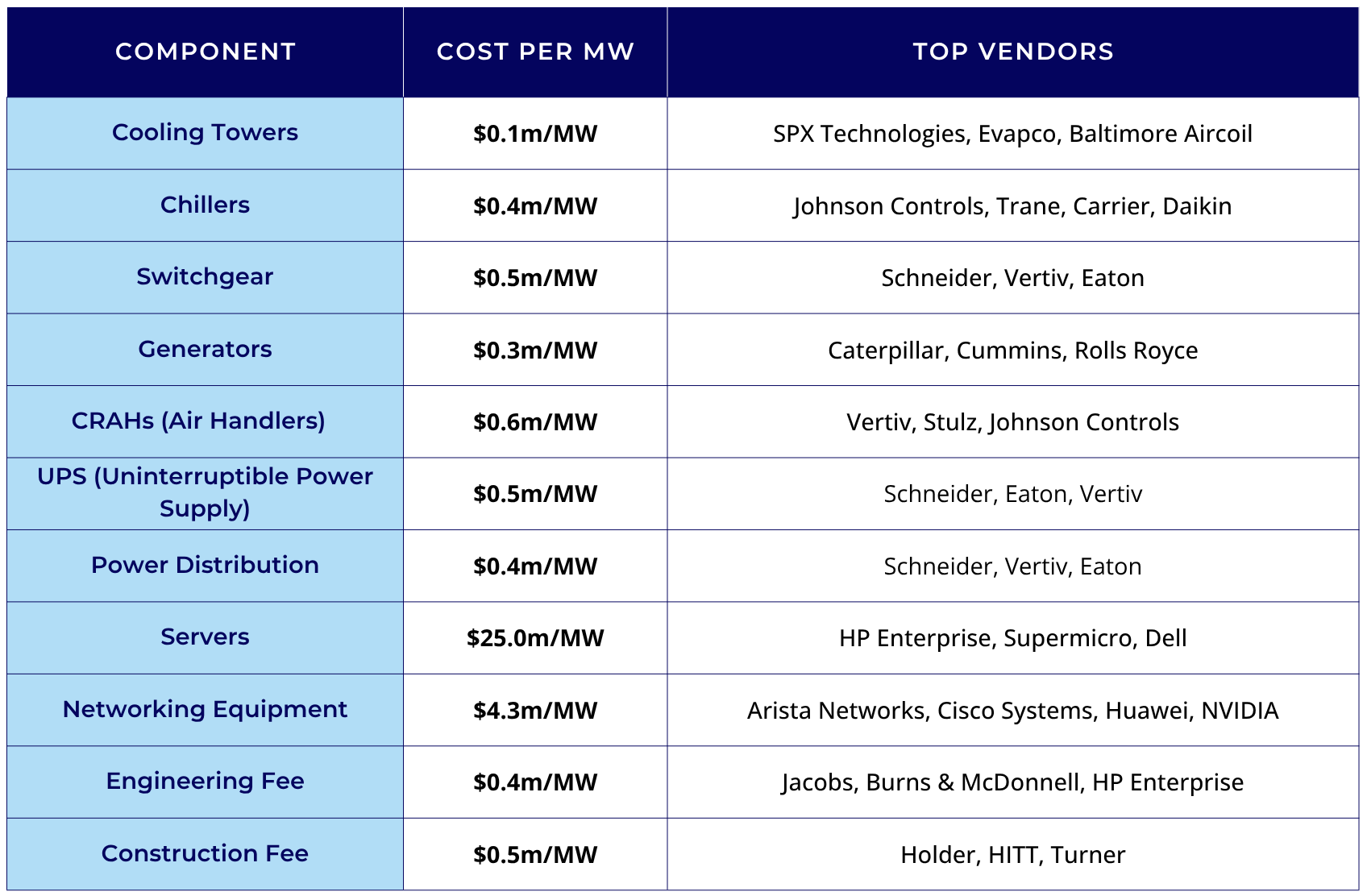
Why this matters: Servers dominate absolute dollars, but electrical and thermal systems dictate whether dense AI racks actually deliver rated performance and uptime. Those “supporting” categories punch above their weight in both schedule risk and margin leverage.
The AI Tipping Point and Physical Demand Curve
AI’s impact on infrastructure has hit escape velocity. In 2025, AI workloads consumed 13% of total data center compute. That’s projected to double to 28% by 2027. And it's not just model training anymore - it’s real-time inference at scale. Hyperscalers (Amazon, Microsoft, Google, Meta) are embedding AI into every workflow, product, and process.
This is driving a $345 bn. hyperscaler capex wave in 2025 alone, with spending growing at a 19% CAGR through 2029. Nvidia’s data center revenue surged 73% YoY. Meta alone raised its 2025 capex guidance to $64–72 bn. For every delayed project, three more appear.
Compute Layer: Chips, Servers, and the Race to Scale
The semiconductor layer is the engine room. Over 1 million 8-GPU server units are expected to be deployed globally by 2026, needing more than 12 million chips. Nvidia still leads, but AMD, Intel, and in-house silicon like Amazon’s Trainium or Google’s TPU are gaining share.
Contract manufacturers like Supermicro, Quanta, Foxconn, and Wiwynn are essential nodes in this chain - operating fabs across Taiwan, Vietnam, and California. The shift to real-time AI inference requires custom server racks, denser power loads, and liquid-cooled designs.
This is triggering a semiconductor capex flywheel that could top $1 tn. through 2028, largely secured via backlog commitments and hardware roadmaps. Hardware is no longer commoditized - it’s the bottleneck.
Power: The Alpha Bottleneck
Data centers consumed about 2% of global electricity in 2024. By 2035, that could rise beyond 10%. In the US, AI data centers are responsible for half of the 1% annual load growth through the decade.
In Ireland, data centers now consume 25% of grid capacity, triggering moratoriums. In Virginia and Silicon Valley, grid approvals are taking 5–10 years. According to Schneider Electric’s 2025 survey, 44% of operators now report utility wait times exceeding 4 years, forcing a rethink in power procurement.
Time-to-power is now a competitive advantage. A 1-year lead in power delivery equates to $3 - 4 million per MW in value, surpassing many plant construction costs.
Top “power de-bottlenecking” strategies:
- Bitcoin mining conversions: Core Scientific and IREN are repurposing pre-wired, cooled sites
- SMR/Nuclear PPAs: Microsoft signed 835 MW; Meta secured 1.1 GW of nuclear baseload
- Onsite gas turbines and fuel cells: Bloom Energy is emerging as a key enabler
- Off-grid builds: Fast but operationally risky, now expanding in Texas
The power plant side now has asymmetric upside. Gas-fired redevelopment at Homer City (4.5 GW) is expected to cut emissions by 60–65% per MWh. In Europe, replacing coal with clean gas and nuclear is key to unlocking AI infrastructure.
Thermal & Cooling Systems: The Underappreciated Capex
AI servers generate heat loads 3–5x traditional cloud setups. By 2027, rack densities will exceed 176 kW, up from 162 kW in 2024. Air cooling is hitting its limits.
Liquid cooling and immersion systems are being scaled by Daikin, Carrier, IBM, and Schneider. Startups in Europe and Asia are delivering containerized immersion units. According to industry surveys, 62% of operators now factor in thermal optimization during initial design.
This changes the HVAC opportunity:
- It’s not commoditized cooling anymore
- It’s integrated thermodynamic design
- Customization drives margin - especially in training clusters
These players are now reporting record order books, driven by AI-specific data centers.
Construction & Real Estate: A New Industrial Asset Class
In 2025, US data center construction is expected to hit $28 bn. - 36% of all private non-residential spending. By 2030, that share may exceed 10%. This isn’t speculative buildout; it’s hyperscaler-backed, demand-secured infrastructure.
REITs and infrastructure platforms are adapting:
- Equinix, Digital Realty: Still leasing, but shifting to self-build
- Prologis: Building out 3–4 GW in medium term, with 25–50% margins
- Blackstone: Targeting secondary markets and edge colocation
- Switch, QTS, Stack: Playing both scale and speed
Lead times for critical components—turbines, switchgear, cooling sit between 100–150 weeks. Supply chain resilience is now a core investment factor. Pre-fab modules and vertical integration are emerging themes.
Utilities and Grid: The New Epicenter of Risk and Return
Electricity is the backbone of digital infrastructure, yet grid systems are strained and lagging. The U.S. alone has a 2,500 GW interconnection queue — nearly 20x current demand. The average data center grid approval now takes 5–10 years, particularly in high-demand zones like Northern Virginia and California.
Key challenges:
- Permitting delays
- Local political opposition
- Aged transmission infrastructure
- Regional mismatch of supply and demand
As a result, hyperscalers are entering joint ventures with utilities to de-risk power procurement. Some are even funding their own substations and transmission lines. In Europe, sovereign cloud mandates are clashing with green energy limits. Ireland’s cap on new data center connections is a cautionary tale.
Opportunities for utility investors:
- Grid operators with modernized permitting processes
- Transmission developers aligned with hyperscaler capex
- SMR deployment partners (e.g., NuScale, TerraPower)
- Fuel cell companies (e.g., Bloom Energy) offering modular generation
Utilities are no longer defensive, regulated plays - they are emerging as AI infrastructure catalysts.
ESG and Sustainability: From Risk to Competitive Edge
AI’s carbon footprint is real. According to Morgan Stanley, data centers will contribute 215 million tons of CO₂ by 2030, equivalent to 0.6% of total global emissions. The push for clean compute is no longer just regulatory - it’s strategic.
The Green Reliability Premium (GRP) - the cost of securing 24/7 carbon-free energy is now $40/MWh, projected to rise to $48/MWh post-2026 as U.S. tax credits decline. Hyperscalers are absorbing these costs because the alternative is project delay... or reputational damage.
ESG-Linked Capex Trends:
- Meta and Google investing in carbon-matched PPAs
- Microsoft supporting modular nuclear reactors
- France leveraging nuclear grid (65% nuclear) to attract AI workloads
- Middle East pushing solar + battery to power sovereign AI ambitions
This shift creates new pricing power for clean power providers - especially those offering firm baseload like hydro and nuclear. Regions with low-carbon grids are gaining competitive advantages in attracting AI infrastructure.
Global Capacity Race: Regional Winners and Bottlenecks
- The U.S. remains the core engine of the global data center buildout, with 37 GW of capacity in 2024, growing at +26% CAGR through 2030. Northern Virginia, Silicon Valley, Phoenix, and Texas lead... but are reaching saturation. Secondary markets (e.g., Atlanta, Tennessee) are next.
- China is set to hit 42 GW by 2028, growing at 16% CAGR, driven by Tencent, Baidu, Alibaba, and ByteDance. The main constraint is chip availability, not power.
- Middle East markets like Saudi Arabia and UAE are growing 6–7x by 2030, thanks to sovereign funding and U.S. partnerships. The UAE’s Stargate (5 GW) and Saudi HUMAIN (500 MW, $5B) are landmark AI infrastructure plays.
- Europe lags on capacity due to permitting and energy constraints. But France (with nuclear edge), Spain, Milan, Zurich, and Berlin are gaining ground. Dublin faces a data center freeze.
Global investors must factor in regional readiness - not just hyperscaler demand - when evaluating infrastructure equities and REITs.
Data Center Investment Value Chain: Multi-Sector Alpha Map
Data centers are no longer just a REIT or cloud play. They touch semiconductors, power, HVAC, utilities, real estate, and materials. Here's how the opportunity map looks:
.png)
Valuation Frameworks: Time-to-Power and Premia
Traditional valuation models often miss the value embedded in “time-to-power” arbitrage. According to Morgan Stanley:
“The value of a 1-year time advantage is $3–4 million per megawatt, often exceeding total power plant capex.”
This is why Bitcoin-to-AI conversions have become attractive despite operational complexity. In recent deals, power premia exceeded 300% - but still made sense from the AI operator’s perspective due to lost inference revenue from delay.
Strategic Investors Should Consider:
- Enterprise Value / Watt (EV/Watt) for mining site conversion targets
- Power cost per MWh vs. GRP-adjusted returns
- Lease duration vs. compute depreciation curve
- Regional PPA availability and clean energy mix
Risks and Headwinds (With Practical Mitigants)
- Policy and permitting: Moratoriums, water limits, transmission approvals. Mitigants: multiple parallel sites; early community engagement; water-saving cooling designs; phased NTP (notice-to-proceed) linked to interconnect milestones.
- Power price volatility: Fuel and congestion risk. Mitigants: PPAs with collars; diversified procurement; on-site generation where feasible.
- Technology cadence risk: Faster efficiency gains (quantization, sparsity) or architectural shifts (memory-centric compute) could lower server $/MW growth and diminish thermal content. Mitigants: modular designs; flexible thermal/power topologies.
- Supply-chain constraints: 100–150-week lead items drive schedule variance. Mitigants: early purchase orders; framework agreements; prefab modules.
- Tenant concentration and credit: Overweight exposure to a single hyperscaler. Mitigants: staggered expiries; multi-tenant corridors; step-down covenants.
AI Infrastructure Is Its Own Sector Now
AI is no longer a horizontal tool - it’s a vertically integrated infrastructure play. From silicon to substations, liquid cooling to low-carbon baseloads, data centers are the factories of intelligence.
This is a new industrial age… and the most capital-intensive one since the internet’s birth. Investors and operators who understand where the bottlenecks lie, who controls the inputs, and how power dynamics shift, will create long-term alpha.
Discover the Lean Advantage: Offshore Insight Onshore Impact
Lean Research enhances your investment strategy by delegating the detailed grunt work to our offshore analysts, freeing your onshore teams to focus on high-value tasks. With our dedicated full-time members embedded in your operations, we ensure that every piece of analysis not only meets but exceeds your standards. Experience the ease of expanding into new markets and asset classes while driving better investment returns, all in a cost-efficient manner. Lean Research is your partner in redefining asset management efficiency.