
The Expanding Role of Data Centers
With more and more businesses going digital, the importance of data centers is on the rise. These infrastructures are the foundations of data management, processing, and computing services, thus in the management of all global digitization. Furthermore, Data centers have evolved into a core investment strategy which is also a fundamental asset class due to the rising demand actuated by artificial intelligence (AI) and the cloud. In this blog, we explore key factors driving data center growth, the supply-demand dynamics, and the risks that investment analysts and fund managers should consider when analyzing this market.
Data Centers: A New Utility for the Digital Economy
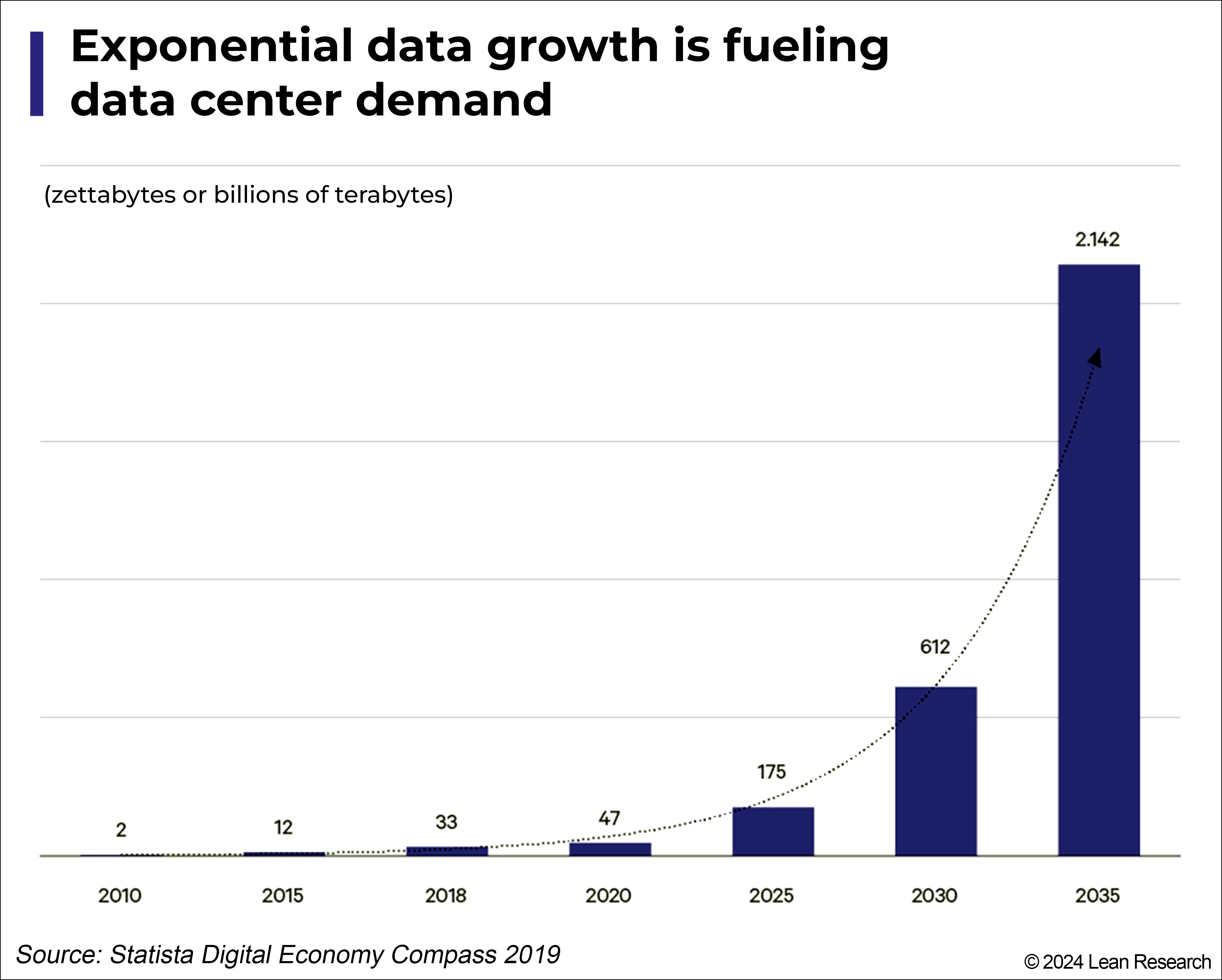
With the increasing demand for data across the world, data centers have come to become critical components of infrastructure, similar to the power sources of the industrial age. Such facilities, which provide necessary resources to various sectors, including finance, telecommunications, and media services, as well as health care services, are classified as critical IT infrastructure. These allow cloud computing and technologies like AI and big data to grow.
It has been estimated that by 2024, the amount of information produced will surpass the amount produced in the year 2022 by 2x. The influence of that generated activity is creating a huge appetite for such structures as data centers. But, unlike conventional forms of property investment, data centers are quite complex; strategic aspects with respect to these assets are comprised of both infrastructure and real estate investments.
Real Estate or Infrastructure? Understanding the Asset Class
While data centers are often thought of as simply physical buildings for the purposes of real estate, they are also capable of critical functions such as storing, processing and connecting digitally to the data that they house, more like infrastructure assets. For the most part, data centers are able to guarantee stable and recurring incomes to their owners due to the availability of medium and long terms lease agreements with tenants.
Financial Viewpoint:
- EBITDA Margins: Hyperscale data centers often achieve EBITDA margins of 50% or more, significantly higher than other real estate sectors. This is largely due to long-term contracts and the scale of operations.
- FFO (Funds from Operations): Data center REITs generally report higher FFO than other REIT sectors. Digital Realty Trust and Equinix have consistently outperformed, with strong FFO growth driven by increasing demand for digital infrastructure.
- ROIC (Return on Invested Capital): For developers and institutional investors, data centers offer competitive ROIC. High-demand locations and cutting-edge facilities designed for AI and cloud workloads tend to yield strong returns compared to traditional infrastructure.
Nevertheless, a reliable power supply is a fundamental difference when it comes to data centers and other types of real estate investment properties. Unlike in typical office space leases, tenants in data centers do not rent floor space; they pay for a specific level of electricity and computing resources on demand. Data centers will have to enhance their power capacity as the amount of AI workloads and cloud computing increases, which complicates the investment picture even further.
The Power Bottleneck: A Critical Factor in Data Center Operations
Unlike traditional real estate, where rents are determined by square footage, data center rents are often calculated based on power consumption (measured in kilowatts or megawatts). At present, U.S data centers account for only 2.5% of total electricity consumed in the country. This statistic is likely to grow 2 times more, that is up to 7.5% in the year 2030. In major markets such as Northern Virginia, which houses nearly half of the data center capacity in the United States, it has also become difficult to obtain a connection to power grids or even enhance existing connections due to the high levels of demand and low grid capacity regionally.
The problem is also exacerbated by the rise of AI, since AI servers require more power than conventional servers. Data centers would need to implement additional technologies — such as liquid cooling and on-site power generation — to cope up with the increase in energy consumption that is expected. Power restrictions are expected to prevent a high degree of vacancy in data centers, especially in regions of high demand.
Supply and Demand Imbalance
The rapid expansion of digital infrastructure has created a persistent supply-demand imbalance in the U.S. data center market. While record levels of construction have significantly increased data center capacity, demand continues to outpace supply, particularly in power- and land-constrained regions.
By the end of 2024, the U.S. data center inventory is projected to have nearly doubled, adding over 3,300 megawatts (MW) of capacity. However, despite this expansion, vacancy rates remain historically low, with some key markets—such as Northern Virginia—experiencing vacancies below 1%. The vacancy rate is expected to remain tight through 2025, before seeing a slight rise post-2026 as supply growth stabilizes.
Looking forward, data center absorption is projected to remain strong in the coming years, although it is expected to gradually decline post-2025, reflecting normalization in demand and market saturation. However, rental rates are likely to stay elevated, as ongoing supply constraints and surging AI-driven data processing needs continue to exert upward pressure on pricing.
Investment Strategies in Data Centers
- REITs (Real Estate Investment Trusts): Publicly traded REITs such as Digital Realty and Equinix allow investors to gain exposure to the data center market without owning the physical assets. These REITs have historically provided stable dividend yields and capital appreciation.
- Private Equity: Private equity funds have been highly active in acquiring data centers as part of their infrastructure portfolios. These funds offer investors exposure to early-stage developments and high-growth opportunities, often with higher potential returns than REITs.
- Direct Ownership and Development: Institutional investors and developers can build or acquire data centers directly. This allows for greater control over the asset and the ability to capture higher returns by meeting the specific needs of hyperscale tenants, but it also comes with higher risks, including power access and obsolescence.
M&A and Investment Activity in Data Centers
The data center industry has witnessed a surge in M&A and investment activity, fueled by strong demand fundamentals and rising investor interest in digital infrastructure. Private equity and institutional investors have increasingly targeted data center assets, reshaping the sector through large-scale transactions, refinancing, and take-private deals.
As depicted in the chart, global data center deal activity hit record levels in 2022 and 2023, both in deal value and number of transactions.
- 2022 saw the highest transaction value, exceeding $65 billion, driven by major M&A and take-private deals.
- 2023 remained strong, with over 135 deals, fueled by greenfield investments, refinancing, and public offerings.
- M&A continues to dominate, but greenfield projects and refinancing activity have grown significantly, reflecting expansion strategies and capital restructuring in the sector.
This investment boom highlights the increasing recognition of data centers as a strategic asset class, with long-term growth potential as cloud computing, AI, and edge infrastructure drive demand for scalable and high-efficiency digital infrastructure.
Risks: Obsolescence, Sustainability, and Power Constraints
Investing in data centers is not without risks. The rapid pace of technological change means that older facilities may become outdated if they cannot support new workloads, particularly those driven by AI. Investors should prioritize facilities that are adaptable and can scale with future technological needs.
Sustainability is another growing concern. Data centers currently account for 1% of GHGs, and this figure is expected to rise as more facilities come online. As environmental regulations tighten, data center operators will need to invest in renewable energy sources and energy-efficient designs to remain competitive.
Finally, power constraints will continue to be a challenge, particularly in regions where the demand for electricity is greater then supply. These power bottlenecks will likely keep supply limited, driving up rental rates and increasing competition for grid access.
Outlook: AI and Cloud Driving Demand
The global data center market is expanding rapidly, driven by AI adoption, cloud computing, and increasing digital infrastructure investments. While the U.S. remains the largest market, Asia-Pacific and Europe are experiencing significant growth, particularly in Singapore, Hong Kong, Japan, London, and Frankfurt. However, these regions face energy constraints and evolving environmental regulations, shaping future development strategies.
Generative AI spending is projected to surge significantly by 2028, with AI investment accounting for an increasing share of total IT budgets. This explosive AI growth will drive further data center demand, particularly for hyperscale infrastructure as major tech firms race to scale AI-driven computing power. Meanwhile, edge computing is emerging as a complementary solution, enabling low-latency processing for real-time applications by deploying smaller data centers closer to end users.
For investors, AI-driven demand presents major global opportunities, especially in markets prioritizing cloud expansion, digital economies, and AI infrastructure development. As AI spending accelerates, data centers will remain a critical enabler of future digital transformation.
Conclusion
In the age of the digital economy, data centers are becoming more and more recognized as an asset class. With AI and the advancements of cloud computing, the appetite for data will keep soaring globally and the demand for more advanced and larger data center facilities will certainly grow. For investors, especially for those who are building data centers, it is significant to comprehend the technical, operational, and power constraints of data centers to make rational investment decisions.
Discover the Lean Advantage: Offshore Insight Onshore Impact
Lean Research enhances your investment strategy by delegating the detailed grunt work to our offshore analysts, freeing your onshore teams to focus on high-value tasks. With our dedicated full-time members embedded in your operations, we ensure that every piece of analysis not only meets but exceeds your standards. Experience the ease of expanding into new markets and asset classes while driving better investment returns, all in a cost-efficient manner. Lean Research is your partner in redefining asset management efficiency.