
Quick Take: Japan’s Sovereign Debt Strain and Global Spillover Risks
Executive Summary
Japanese 30-year bond yields have reached levels unseen since 1999, marking one of the sharpest moves in decades. The convergence between Japanese and U.S. long-term yields signals a potentially transformative change in global capital flows, carrying significant implications for global debt markets and currency valuations. Japan’s rising yields, mounting debt burden, and inflation resurgence expose systemic vulnerabilities that could cascade into the global financial system.
Market Context and Key Developments
- Japanese 30-year government bonds (JGBs) have risen ~14 basis points, pushing yields to their highest since 1999.
- The yield gap between Japanese 30-year and U.S. 10-year bonds is narrowing rapidly, raising concerns about shifts in international capital allocation.
- Some analysts suggest that when these yields converge, it could mark the inflection point for a global debt repricing — possibly triggering a broader debt-market correction.
Japan’s Sovereign Debt Landscape
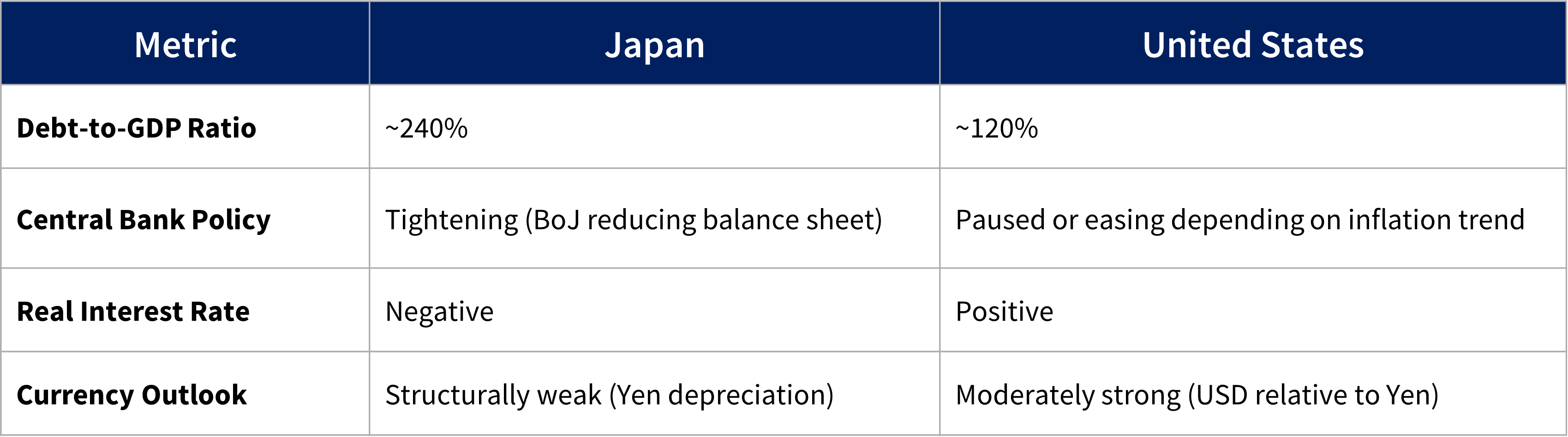
- Japan’s sovereign debt exceeds $10 trillion, approximately 2.4x its GDP, making it one of the most indebted economies globally.
- Interest costs now consume nearly 25% of the national budget, reducing fiscal flexibility.
- For decades, near-zero or negative inflation allowed the government to finance deficits via quantitative easing (QE) — the Bank of Japan (BoJ) monetized debt to suppress yields.
- However, as inflation returned (averaging ~3% over the past three years), the BoJ has been forced to halt bond purchases and begin balance sheet reduction, turning from a net buyer to a net seller of JGBs.
- The withdrawal of BoJ support has triggered an abrupt rise in yields and weakened the yen, mirroring early-stage symptoms of a sovereign debt crisis.
Inflation Dynamics and Policy Reversal
- Historically, Japan’s inflation hovered around 0% or below, fostering a deflationary environment.
- The recent sustained price growth undermines the foundation of Japan's debt-financing model, which depended on stable, ultra-low inflation.
- The BoJ’s balance sheet contraction since 2022 demonstrates an attempt to normalize policy, but it has unleashed market volatility as the private sector reabsorbs government debt at higher rates.
Global Linkages and Spillover Effects
- Japan holds over $1 trillion in U.S. Treasury securities, making it the largest foreign holder of U.S. debt.
- A sustained rise in Japanese yields may incentivize repatriation of capital — potentially reducing Japanese demand for U.S. Treasuries.
- Nevertheless, the argument that this would immediately cause U.S. yields to spike is overstated.
- The U.S. debt-to-GDP ratio (1.2x) remains less extreme than Japan’s 2.4x.
- U.S. real (inflation-adjusted) interest rates remain positive, contrasting with Japan’s negative real rates, which continue to make the U.S. dollar a more attractive currency for investors.
Market and Trading Implications
- The yen’s weakening trajectory has reinforced dollar strength in 2024–2025, even as the U.S. Dollar Index (DXY) has softened against other major currencies.
- This divergence has helped support gold, silver, and Bitcoin, which typically rise when the dollar loses purchasing power.
- For traders, exposure can be balanced through:
- Short positions on the yen, as a hedge against inflationary shocks and a strong dollar.
- Long positions on hard assets (metals, commodities) to benefit from dollar weakness and inflation trends.
- The dual exposure — long real assets, short yen — provides a structural hedge within multi-asset portfolios.
Broader Macroeconomic Implications
- Japan’s tightening and rising yields reveal the limits of prolonged monetary accommodation in heavily leveraged economies.
- If Japan is forced to resume QE despite inflation, it risks currency collapse and capital flight — potentially destabilizing global bond markets.
- Conversely, the U.S. maintains relative resilience, at least in the short term, as its higher real rates keep the dollar dominant.
- The convergence of global yields, however, suggests a gradual repricing of sovereign debt risk across all developed markets, possibly signaling the end of the ultra-low-rate era.
Comparative Fiscal Sustainability
Discover the Lean Advantage: Offshore Insight Onshore Impact
Lean Research enhances your investment strategy by delegating the detailed grunt work to our offshore analysts, freeing your onshore teams to focus on high-value tasks. With our dedicated full-time members embedded in your operations, we ensure that every piece of analysis not only meets but exceeds your standards. Experience the ease of expanding into new markets and asset classes while driving better investment returns, all in a cost-efficient manner. Lean Research is your partner in redefining asset management efficiency.