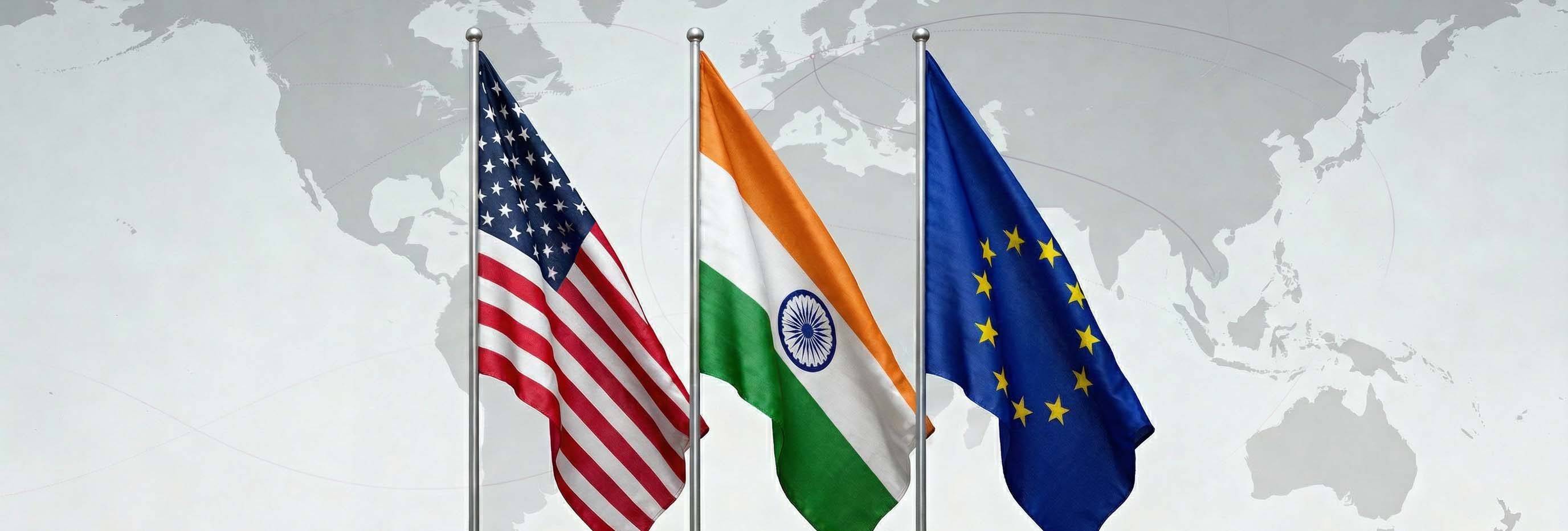
India's Landmark 2026 Trade Deals: The 'Father' and 'Mother' of All Agreements
Quick Takeaways
- US-India trade deal finalized February 2026 slashing tariffs from 50% to 18%
- EU-India FTA signed January 2026 providing duty-free access to 99% of Indian exports
- India commits to $500 billion "Buy American" program and cessation of Russian oil imports
- Combined bilateral trade projected to exceed $350 billion by 2030
- Textiles, pharmaceuticals, and automotive sectors positioned for 6-7 million new jobs by 2028
The global trade map was redrawn in the final weeks of January and early February 2026. India, long viewed as a cautious negotiator in the world of Free Trade Agreements (FTAs), has pivoted into an era of unprecedented openness. Two landmark agreements, the EU-India Free Trade Agreement and the US-India trade deal, have shifted from aspirational discussions to concrete, finalized frameworks. These are not merely tariff adjustments but tectonic shifts in geopolitics and supply chain architecture.
In the words of Commerce Minister Piyush Goyal, the EU-India pact is the "Mother of All Deals" for its sheer complexity and regulatory depth, while the US agreement is the "Father of All Deals" for its sheer scale and the radical reset it demands of India's energy and diplomatic posture. Together, they represent a "Mega-Partnership for Prosperity" that could define the Indian economy for the next quarter-century.
Executive Summary The 2026 Breakthrough
As of February 4, 2026, the landscape has fundamentally transformed with both India bilateral trade agreements now finalized.
The US-India Deal announced February 2, 2026, by President Trump and PM Modi slashes US tariffs on Indian goods from a punitive 50% down to a consolidated 18%. In return, India has committed to a historic $500 billion "Buy American" program and a cessation of Russian oil imports, marking a major shift in India trade policy 2026.
The EU-India FTA signed January 27, 2026, grants immediate duty-free access to 70.4% of Indian tariff lines, covering over 90.7% of India's export value. By its full implementation, 99% of Indian exports will enter the EU without duties, creating unprecedented India export opportunities.
The geopolitical pivot shows India has officially decoupled its energy security from Russia in exchange for market access to the West, signaling a permanent realignment in its "Strategic Autonomy" doctrine.
Economic forecast indicates combined bilateral trade with the US and EU is now projected to exceed $350 billion by 2030, a massive jump from the $212 billion levels seen in late 2024.
The Core Story A Tale of Two Agreements
For nearly two decades, the India-EU BTIA (Bilateral Trade and Investment Agreement) remained stalled in the halls of Brussels and New Delhi. Negotiations that began in 2007 were often delayed by disagreements over Scotch whisky duties, professional mobility, and dairy protections. Simultaneously, trade relations with the US hit a nadir in 2025 as the "reciprocal tariff" battle escalated to a staggering 50% levy on Indian goods.
The EU-India FTA The "Mother" of Stability
The signing of the EU-India FTA on January 27, 2026, marked the end of an era of protectionism. Covering a market of 1.9 billion people, this India-EU trade agreement is termed "Mother" because it nurtures the entire ecosystem from the Assamese tea gardens to the semiconductor labs of Bengaluru.
The agreement is designed as a "compassionate mother," as Goyal noted, balancing the interests of the 27 EU member states and the 1.4 billion people of India. Crucially, it secures zero-duty access for Indian labor-intensive sectors like textiles, footwear, and leather, which had previously faced a 10-17% disadvantage compared to competitors like Vietnam.
The US-India Deal The "Father" of Hard Realities
If the EU deal is about nurturing growth, the US-India trade deal 2026 finalized via a historic phone call on February 2, 2026, is about hard-nosed reciprocity. The "Father of All Deals" was triggered by President Trump's insistence on "Reciprocal Trade."
The deal's primary achievement is the reduction of the US tariff rate from 50% to 18%. This 18% rate is a strategic masterstroke for India as it is lower than the 19% faced by Pakistan and the 20% faced by Vietnam. This gives India a 1-2% pricing advantage in the world's most lucrative consumer market. However, the cost is a total reset of India's energy map. India's commitment to halt Russian oil purchases, which accounted for nearly 35% of its supply, reorients its dependency toward American and Venezuelan crude.
Comparative Analysis of Impact 2026 Data
Deep Dive Transformative Industry Shifts
Textiles and Apparel Reclaiming the Crown
For years, the Indian textile industry was the "underdog" against Bangladesh and Vietnam due to high tariffs. Under the 2026 India trade agreements, the landscape has completely transformed.
In the EU, Indian garments now enter duty-free. This removes the 12% price disadvantage overnight, creating immediate India export opportunities worth billions.
In the US, the drop from 50% to 18% is a survival lifeline for MSMEs in Tirupur and Ludhiana. The Indian government estimates that this sector alone will generate 6 to 7 million new jobs by 2028 as global brands shift procurement from China to India.
This represents a complete transformation of India manufacturing competitiveness in the textile sector, positioning India to reclaim its historical position as a global textile powerhouse.
Automotive and Machinery The Bridge to Europe
The EU-India FTA 2026 includes a "Quota System" for automobiles. While India maintains high tariffs for general imports to protect domestic makers like Tata and Mahindra, it has allowed 250,000 European vehicles to enter at a mere 10% duty. This allows luxury European brands including BMW, Mercedes, and Audi to expand their presence while India gains duty-free access for its own auto components and EV parts into Europe.
This balanced approach ensures India's domestic automotive industry remains protected while securing critical market access for Indian auto component manufacturers, a sector projected to add 200,000-300,000 jobs by 2028.
Pharmaceuticals From "Pharmacy of the World" to "Partner of the West"
The EU-India trade deal eliminates tariffs on €1.1 billion of pharmaceutical exports. More importantly, it aligns regulatory standards. Indian generics will now face fewer hurdles in the European Medicines Agency (EMA) approval process.
In the US, the deal focuses on "de-risking" the pharmaceutical supply chain away from China, with the 18% tariff providing a stable environment for Indian API (Active Pharmaceutical Ingredient) manufacturers. This India tariff reduction in pharmaceuticals could boost exports by 40% within the next three years, cementing India's position as a critical healthcare supplier to Western markets.
The Geopolitical "Catch" The Russian Oil Factor
The most debated aspect of the 2026 US-India trade agreement is the Russian Oil Halt. Since 2022, India had leveraged discounted Russian Urals to keep its domestic inflation in check. However, the US-India deal makes the 18% tariff contingent on India ending these imports.
Refining Math shows Indian refiners like Reliance and IOC must now reconfigure their complex refining systems to process US WTI and Venezuelan blends. While these are currently more expensive than Russian crude, the trade-off is the $40 billion in annual tariff savings for Indian exporters.
The $500 Billion Commitment represents India's promise to "Buy American" covering defense (MQ-9B drones, jet engines), commercial aircraft (Air India/Indigo orders), and energy (LPG/LNG). This ensures that while India spends more on oil, it secures its status as America's "Preferred Strategic Partner."
This energy pivot represents the single largest shift in India's foreign policy since independence, trading energy autonomy for unprecedented market access to the world's two largest economic blocs.
What Remains Uncertain Implementation and Compliance
Despite the signatures in January and February 2026, two significant hurdles remain for full implementation of these India bilateral trade agreements.
SPS and CBAM concerns persist as the EU's Carbon Border Adjustment Mechanism (CBAM) remains a potential threat to Indian steel and aluminum exports. While the FTA provides a dialogue framework, India must green its manufacturing to truly benefit from zero tariffs. This environmental compliance requirement could require $50-100 billion in infrastructure investments over the next five years.
Legal Scrubbing shows the US-India deal is currently an "agreement in principle." The final joint statement and legal documentation could take months to complete, and any delay in halting Russian oil could see the 50% tariffs reinstated. Industry experts suggest full legal ratification may not occur until Q3 2026.
Implementation Timeline for both deals suggests phased tariff reductions rather than immediate implementation. The EU deal provides immediate access on 70.4% of tariff lines, with the remaining 28.6% phased in over 7-10 years. The US deal's 18% rate becomes effective within 90 days of Russian oil cessation verification.
Strategic Industry Recommendations for Indian Businesses
Preparing for Market Opportunities in 2026 and Beyond
For Exporters in textiles, pharmaceuticals, and automotive components, the immediate priority is investing in EU and US regulatory compliance. Companies must align with European Medicines Agency standards for pharmaceuticals, EU textile sustainability requirements, and US automotive safety certifications.
Diversifying product lines to develop premium offerings for Western markets is critical. The zero-tariff environment in the EU and reduced 18% US tariffs create opportunities for Indian manufacturers to move up the value chain from basic commodities to branded, high-margin products.
Building partnerships with European and American distributors, retailers, and supply chain partners should begin immediately to capitalize on the 2026-2027 implementation window.
For Manufacturers across all sectors, technology upgrades are essential. India manufacturing competitiveness depends on adopting Industry 4.0 technologies, automation, and quality control systems that meet Western standards.
Supply chain integration with European and American value chains requires strategic investments in logistics, warehousing, and just-in-time delivery capabilities that Western buyers demand.
Sustainability certifications including carbon footprint reduction, ethical labor practices, and environmental compliance will determine which Indian manufacturers capture the full benefits of these India trade agreements 2026.
Economic Projections Quantifying the 2026 Impact
Trade Volume Growth Forecasts Post-2026 Deals
US-India Bilateral Trade Trajectory shows current 2026 baseline at approximately $140 billion, with projections reaching $200 billion by 2030 based on the 18% tariff advantage and the $500 billion "Buy American" commitment.
EU-India Trade Expansion stands at approximately $135 billion in 2025, projected to reach $150-180 billion by 2030 as the duty-free access on 99% of exports takes full effect.
Combined Impact suggests total trade with US and EU could exceed $350-380 billion by 2030, representing a 65% increase from 2025 levels and fundamentally transforming India's export profile.
GDP Impact Estimates from 2026 Trade Deals
Independent economic analyses project short-term (2026-2028) additional GDP growth of 0.5-0.8% annually directly attributable to these trade agreements, medium-term (2028-2030) cumulative GDP boost of 1.2-1.5% as supply chains fully adjust, and long-term (post-2030) structural competitiveness gains that could add 2-3% to India's baseline GDP growth.
Employment Generation Potential Through 2030
Sector-specific job creation estimates based on 2026 agreement terms include textiles and apparel creating 6-7 million jobs by 2028, automotive and machinery generating 300,000-500,000 jobs, pharmaceuticals adding 200,000-300,000 jobs, IT and digital services producing 400,000-600,000 jobs, and gems and jewelry contributing 150,000-200,000 jobs, with total direct impact of 7.5-9 million jobs by 2030.
Implementation Timeline What Happens Next
US-India Trade Deal 2026 Rollout
Immediate Actions (February-April 2026) include India phasing out Russian oil imports with complete cessation expected by April 30, 2026, US customs implementing the 18% consolidated tariff rate effective 90 days post-verification, and Indian exporters beginning documentation updates for new tariff classifications.
Short-term Milestones (May-December 2026) involve legal scrubbing and final joint statement publication expected by Q3 2026, implementation of the first tranche of the $500 billion "Buy American" commitments in defense and aviation, and monitoring mechanisms established to verify compliance with oil import restrictions.
Medium-term Implementation (2027-2028) includes full supply chain adjustment as Indian refiners complete reconfiguration for US and Venezuelan crude, trade volume monitoring to ensure bilateral targets are being met, and potential tariff adjustments if compliance issues arise.
EU-India FTA 2026 Activation
Immediate Implementation (January-June 2026) shows tariffs eliminated on 70.4% of Indian exports effective immediately from January 27, 2026, Indian customs implementing reciprocal tariff reductions on EU machinery, pharmaceuticals, and select automotive imports, and regulatory alignment processes beginning for pharmaceuticals and food safety standards.
Phased Tariff Reductions (2026-2033) involve remaining 28.6% of tariff lines reduced over 7-10 years with sensitive products like dairy and certain agricultural items protected, automotive quota system of 250,000 vehicles at 10% duty implemented with annual reviews, and CBAM dialogue framework activated to address carbon border taxation concerns.
Long-term Integration (2028-2035) includes full regulatory harmonization in pharmaceuticals expected by 2030, complete tariff elimination on 99% of exports achieved by 2033, and deep economic integration transforming India-EU relationship into a comprehensive strategic partnership.
Frequently Asked Questions About the 2026 Trade Deals
The Road Ahead India's $2 Trillion Export Vision
The "Mother" and "Father" of all deals have provided the runway for India's ambitious goal of $2 trillion in total exports by 2032. By securing the two largest economic blocs, India has effectively "de-risked" its economy from Chinese volatility and positioned itself as the democratic alternative in global supply chains.
The success of these India trade agreements 2026 now depends on the private sector. Industrialists must move beyond the domestic market and invest in the scale required to satisfy European and American demand. The textile sector must add capacity to produce 6-7 million additional jobs. Pharmaceutical companies must upgrade facilities to meet Western regulatory standards. Automotive component manufacturers must integrate into global value chains.
The Geopolitical Dividend extends beyond economics. India's willingness to decouple from Russian energy in exchange for Western market access signals a fundamental realignment in its foreign policy. This pivot toward the US and EU, while maintaining relationships with other partners, positions India as a critical swing state in the emerging multipolar world order.
The Environmental Challenge cannot be ignored. As India scales manufacturing to meet Western demand, it must simultaneously green its industrial base to comply with CBAM and other environmental standards. This requires an estimated $50-100 billion in clean technology investments, creating opportunities for renewable energy, electric vehicles, and sustainable manufacturing.
The Digital Integration accompanying these trade deals includes provisions for IT services mobility, data flow agreements, and fintech market access. India's $245 billion IT sector could expand by 25% in EU markets alone by 2028, while the US market offers opportunities in artificial intelligence, cloud computing, and digital transformation services.
The "Mother" has provided the care through comprehensive, compassionate market access. The "Father" has provided the discipline through hard-nosed reciprocity and strategic commitments. It is now up to Indian industry to deliver the growth, create the jobs, and fulfill the promise of these landmark India bilateral trade agreements that have redefined India's place in the 21st-century global economy.
The February 2026 breakthrough represents not just trade deals but a fundamental reimagining of India's economic future, its geopolitical alignment, and its role as a manufacturing and services powerhouse in an increasingly fragmented world. The next five years will determine whether India capitalizes on this unprecedented opportunity to achieve its $2 trillion export vision and cement its position among the world's leading economies.