
India Steel & Iron Ore Outlook 2030: Growth & Market Trends
India’s Steel Boom: What It Means for Global Iron Ore Markets Through 2030
Over the next ten years, India will reshape the world's iron ore and steel markets. By 2030, China's steel production is predicted to drop by about 77 million tonnes (mt), making India the primary growth engine. During that time, India will be responsible for almost 85% of the growth in global steel output. However, the iron ore industry in India has a unique profile, with large reserves, rising demand, changing cost structures, and substantial infrastructure and regulatory obstacles. In order to give a thorough, forward-looking view of India's steel and iron ore markets and their global ramifications, this blog compiles the most recent data and insights.
India’s Steel Growth: The New Global Powerhouse
From about 25 mt in 2000 to about 150 mt in 2024, India's steel production has increased dramatically. India, the second-largest producer of steel in the world, plans to increase production to about 230 mt by 2030 and nearly double capacity to 300 mt. China's anticipated decline in steel output will be substantially offset by this 130 mt increase over the next six years.
With the help of state-led infrastructure investments and private sector capital expenditures, India's steel output increased at a roughly 10% CAGR from 2020 to 2024 after growing at a roughly 7% CAGR from 2000 to 2020. This momentum is supported by India's projected real GDP growth of 6.5% annually through 2031. However, in contrast to China's historical sharp increases, India's steel intensity—the ratio of steel use per unit GDP—has stayed relatively flat.
Iron Ore Demand and Supply: India’s Self-Sufficiency Strategy
China's significant reliance on imports stands in stark contrast to India's iron ore market. India has been mostly self-sufficient since 2017, and in 2024, it will export roughly 36 mt. An additional 29 bt of resources offer strong long-term potential, while proven and probable reserves range between 5.5 and 6.4 bt, or about 3% of the global total.
Due to regulatory changes like open mine auctions and increased participation from major steel producers, iron ore production has increased at a projected 8% CAGR since 2015, outpacing steel production. By 2030, India wants to increase its iron ore production by about 100 metric tons to 385 metric tons, which would be a little more than the 80 metric tons that have been increased over the previous six years.
Despite rising production, imports are expected to remain modest, growing from around 5 mt to ~ 10 mt by 2030, mainly opportunistic in nature. Conversely, exports are projected to decline sharply—from 30 mt to about 5 mt—as beneficiation techniques enable more efficient utilization of low-grade domestic ore, reducing reliance on exports.
The Cost Puzzle: Logistics, Pricing, and Export Dynamics
The cost structure of iron ore in India is intricate and significantly impacted by logistics. The average cost of mining is about $6 per tonne, but inland transportation adds $12 to $30 per tonne because many mines are located far from ports. When port handling, export taxes, and shipping are taken into account, the weighted average cost for 62% Fe fines on a CFR China basis comes to roughly $82 per tonne, putting India close to the 90th percentile cost curve globally.
The Indian Bureau of Mines and NMDC publish domestic iron ore prices, which mirror international seaborne prices but account for logistical discounts. Premium ore exports are discouraged by India's 30% export duty on high-grade ore (>58% Fe). The absence of export duties on low-grade ore (less than 58% Fe) promotes opportunistic exports, mostly to China.
Due to its close proximity to Odisha mines, domestic ore is more cost-competitive than imports for steel mills on India's east coast. Despite the higher logistics costs, West Coast mills typically choose domestic ore over seaborne imports, keeping India's import volumes relatively low (~5 mt) and preventing the country's import dependency from growing.
Slurry pipelines, conveyors, and private rail networks are examples of ongoing infrastructure investments that could further boost domestic ore competitiveness by lowering inland logistics costs by $6–12 per tonne.
Infrastructure Investments: Unlocking Capacity and Cost Efficiency
The distribution of iron ore production among major players illustrates the market landscape and underscores the role of integrated steelmakers and state-owned enterprises.
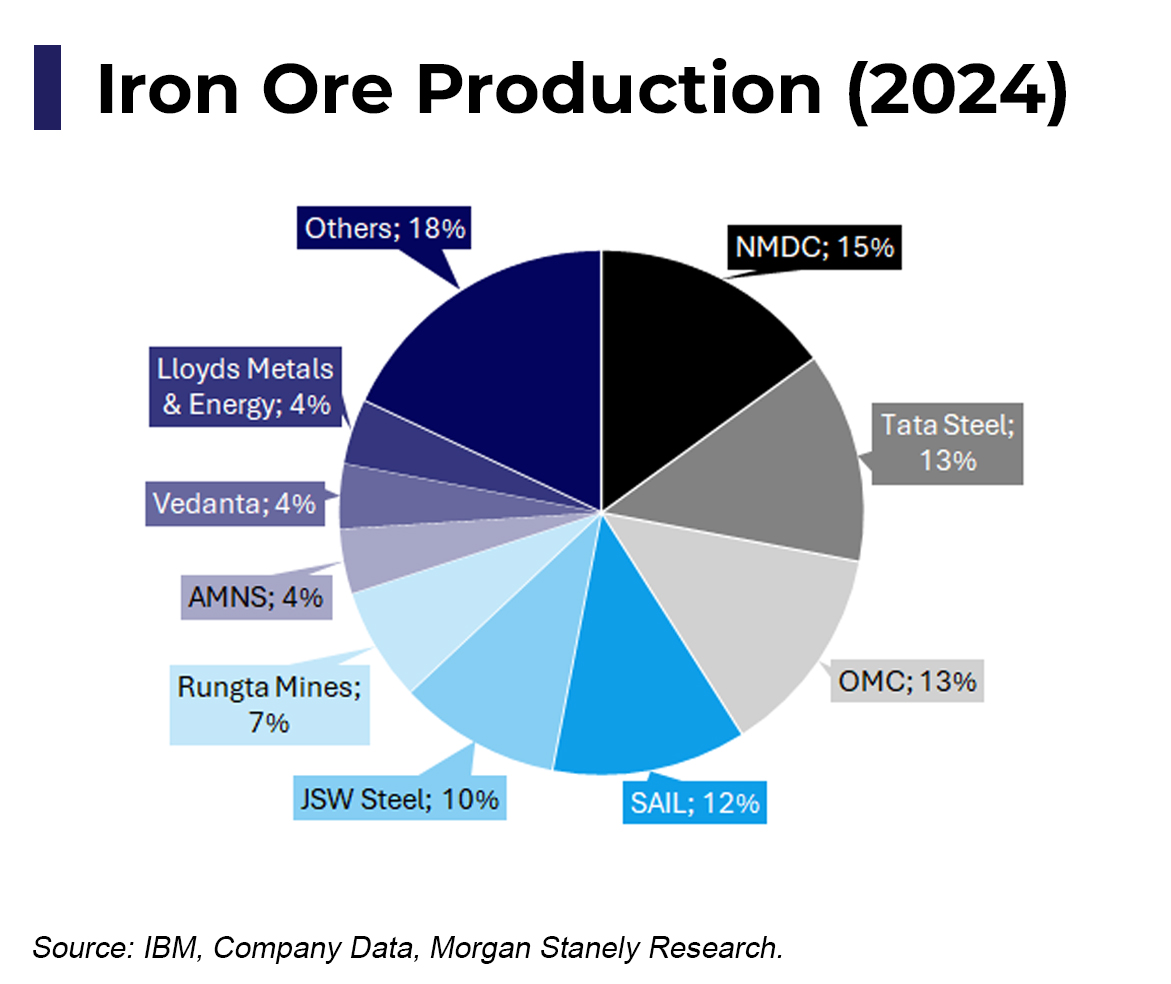
To cut expenses and ensure a captive supply of iron ore, major steel manufacturers such as JSW Steel, JSPL, Tata Steel, and AMNS India are making significant investments in infrastructure. Along with pipe conveyors and private rail rakes, JSW Steel is building a 300-kilometer slurry pipeline that will carry 30 mt annually. AMNS India is in charge of captive port facilities, Tata Steel is increasing its capacity for pellets and building slurry pipelines, and JSPL has put pellet plants and slurry pipelines into service.
These initiatives are essential to reducing the cost of producing iron ore in India and assisting the nation's ambitious plans to increase its steel capacity.
Regulatory and Environmental Bottlenecks: Key Constraints
The pace of mine auctions and their conversion to operational mines can be seen in the chart below, highlighting key trends and recent progress in India’s mining sector.
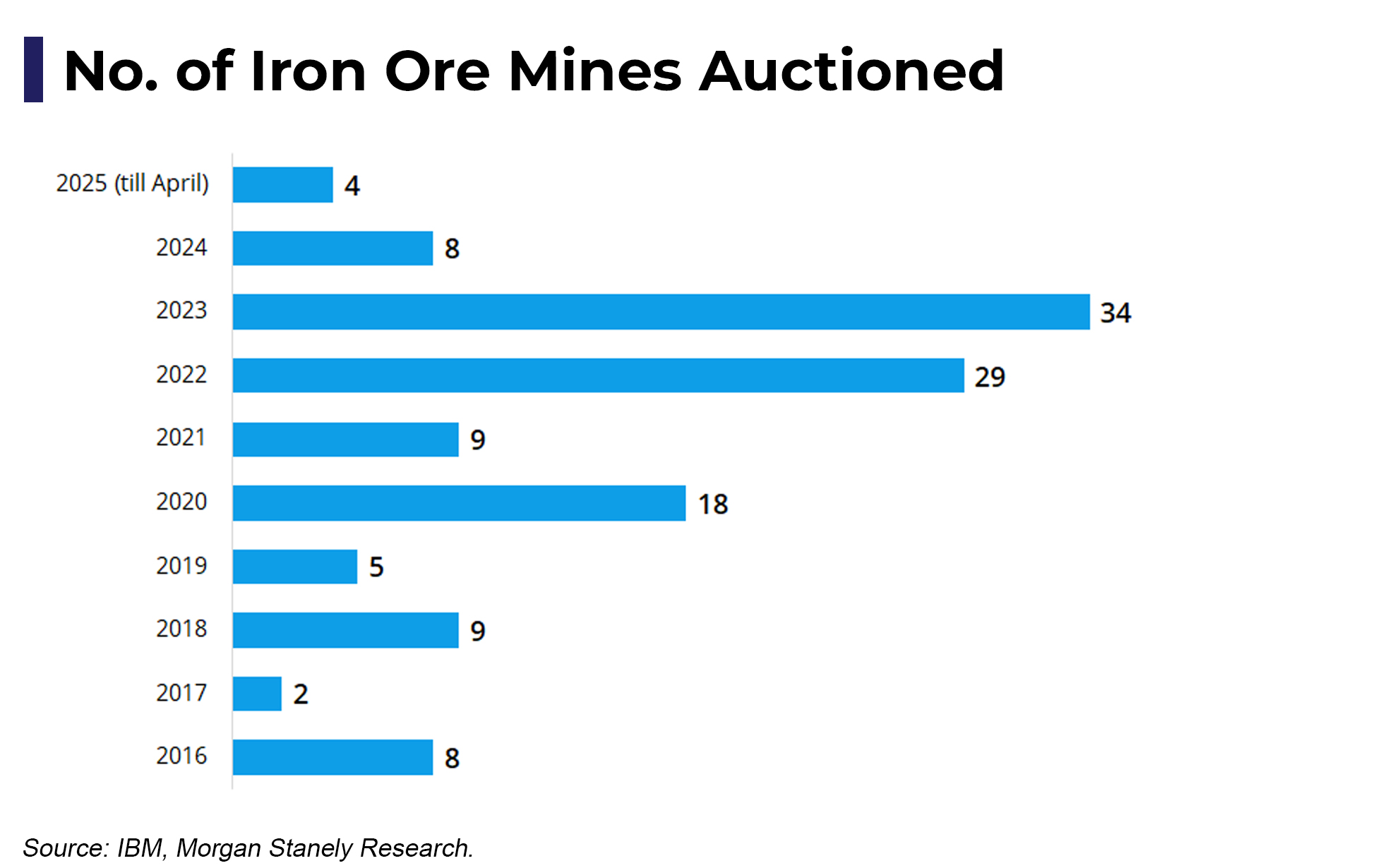
Only 56 of the more than 440 mining blocks that have been put up for auction since 2015 are still in use. About 38% of non-operational mines experience delays, which are mostly caused by regulatory procedures and environmental clearances. In response, the government established specialized committees that report to the prime minister's office once a month. Additionally, the government is working to change the auction rules to speed up mine activations.
Another problem is the decline in ore quality. From 66% of production in fiscal 2018 to 47% in fiscal 2023, the proportion of high-grade ore (>62% Fe) decreased. Beneficiation, which improves low-grade ore and eliminates impurities, is becoming more and more important. Government incentives, such as reduced royalties on beneficiated ore, promote the use of this technology, which also lowers the consumption of coke and increases the efficiency of steelmaking.
Fiscal Pressures and Operational Risks
A Supreme Court decision that gives Indian states the authority to impose mining taxes has created fiscal uncertainty. Unless a unified solution is found, the Rs100 per tonne charges levied by Jharkhand and Karnataka could increase domestic iron ore prices and steelmaking costs.
Labor strikes and a sluggish production ramp-up at the state-owned NMDC, which produced 44 million tons in 2024 but is having trouble reaching its target of 100 million tons by 2030, are examples of operational risks. Private miners and integrated steelmakers are increasing their production. JSW Steel wants to increase their share of captive supply from 37% to 50%, while Tata Steel plans to invest $1.2 billion in mines to increase output from 40 mt to 55 mt.
Price Outlook: Surplus Risks and Volatility
A global iron ore surplus is expected to emerge starting in 2025 as a result of rising domestic production, constrained import growth, and falling exports. The current long-term forecast of about $90 per tonne (real 2024 dollars) will likely be challenged by this surplus, which will push prices lower.
However, the recovery in China's steel demand, new supply from projects like Simandou, and supply-side discipline by producers will all contribute to price volatility.
What to Watch: Key Indicators for Stakeholders
- Speed and scale of mine operationalization from auctioned blocks.
- Production growth rates of integrated producers and NMDC.
- Progress and efficiency of logistics infrastructure projects, such as slurry pipelines and rail connectivity.
- Adoption and effectiveness of beneficiation technologies.
- Government initiatives on regulatory reform and mining tax harmonization.
Conclusion: India’s Steel and Iron Ore Sectors—An Investment Perspective
The emergence of India as the primary force behind the expansion of the global steel industry offers a singular prospect that will transform commodity markets. Strong growth potential is supported by its extensive iron ore reserves and self-sufficiency plan. However, there are actual risks associated with ore quality decline, regulatory delays, infrastructure gaps, and financial strains.
Navigating these obstacles through focused investments in mining capacity, logistics, and beneficiation technology is essential for investors and industry participants to succeed. It will be essential to keep an eye on infrastructure development and regulatory changes.
Only those who comprehend the complexities and maintain their flexibility in this changing environment will be able to benefit greatly from India's steel and iron ore industries. How successfully India can convert its resource wealth into competitive, sustainable steel production will be determined over the course of the next ten years.
Discover the Lean Advantage: Offshore Insight Onshore Impact
Lean Research enhances your investment strategy by delegating the detailed grunt work to our offshore analysts, freeing your onshore teams to focus on high-value tasks. With our dedicated full-time members embedded in your operations, we ensure that every piece of analysis not only meets but exceeds your standards. Experience the ease of expanding into new markets and asset classes while driving better investment returns, all in a cost-efficient manner. Lean Research is your partner in redefining asset management efficiency.