
Generative AI in 2024: Transforming Industries, Overcoming Challenges, and Future Directions
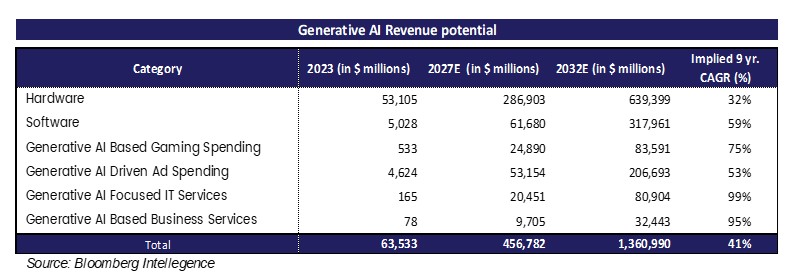
In the year 2024, Gen AI has emerged as a disruptive technology, making changes like no other industry has done in this period. With revenue projections that predict that this area of AI will generate $1.4 trillion in revenues and account for 10-12% of all technology expenditure by 2032, there is an overview of what Gen AI is doing across different sectors, some challenges faced in scaling it and its possible trends.
Introduction: The Generative AI Surge of 2024
In the year 2024, Gen AI has emerged as a disruptive technology, making changes like no other industry has done in this period. With revenue projections that predict that this area of AI will generate $1.4 trillion in revenues and account for 10-12% of all technology expenditure by 2032, there is an overview of what Gen AI is doing across different sectors, some challenges faced in scaling it and its possible trends.
Current Implementation: Generative AI’s Industry-Wide Impact
Finance: Revolutionizing Operations and Customer Engagement
Gen AI has become an operational tool and a customer engagement strategy for financial institutions. In 2024, the uptick in financial investments to boost AI goes substantially ahead. Mainly, such investments go into enhancing fraud detection and improving personalized customer experiences. The average size of AI related deals in finance surged to $28.9 million which is 55% higher compared to 2023 figures. For this reason, finance stands out as one of the most AI-integrated sectors because of business operations improvement due to AI-driven tools.
Healthcare: Accelerating Drug Discovery and Personalized Care
AI is emerging in the field of health care, “75% increased their investments on health-related data management for this reason,” said healthcare organizations. The process of finding new treatments through AI has become faster and cheaper. Personalized care made possible by AI contributed to better patient results according to 10% of health institutions. The healthcare sector saw a record rise in AI worldwide, jumping 59% QoQ so that it hit $23.2 billion in 2024.
Manufacturing: Enhancing Efficiency and Driving Innovation
Generative AI is transforming manufacturing through better supply chains, predictive maintenance measures, and product invention. Yet, 55% of manufacturers have also showed us that they are not able to take advantage of AI due to poor data quality and privacy issues. Despite these hindrances, the industry recorded a 28% rise in AI mega-rounds in Q2 2024 with transactions amounting above $100 million confirming its advanced optimism towards AI’s future in production processes.
Entertainment and Media: Transforming Content Creation
In 2024, nearly half of the media companies were benefiting significantly from AI, 12% looking for more advanced products or services and 10% seeking premium quality content. This industry has many emerging and existing unicorns that are based on AI, especially generative ones.
Challenges and Opportunities: Scaling Generative AI
Scaling Challenge: From Pilots to Full-Scale Implementation
As of 2024, 68% of companies said only about thirty percent or less of their AI projects had been fully implemented. This difficulty is worsened by the notion that putting AI into current systems is not straightforward. In comparison, the United States is still the leader with a bite of half of all global AI transactions made during the second quarter of 2024 as it advances with its complete innovation over a period of time through various initiatives on Artificial Intelligence (AI).
Data Management: The Backbone of AI Success
To successfully use AI, data management has to be done effectively. According to the Deloitte State of Generative AI Survey, in 2024, 75% of organizations were able to invest more money in data lifecycle management, emphasizing on bettering data security (54%), increasing data quality (48%) and reinforcing governance frameworks (45%). Nevertheless, even though these steps have been taken, 55% of firms still shun away from some AI applications because of data-related challenges that indicate a clear need for fierce data administration regulations.
Navigating Regulatory and Risk Management Challenges
AI is becoming more and more significant in the operations of various businesses. However, 23% of businesses are very well prepared for the challenges that such changes pose. One major area of concern is regulatory uncertainty regarding AI legislation proposed at EU level; 36% firms are thus anxious about meeting their obligations. By imposing potential penalties up to 7% of annual income, the AI Act requires that strong governance frameworks are put in place to avert risks.
Future Prospects: The Next Frontier of Generative AI
Top Ranked Verticals in Generative AI Economy
Dominating the Creative Industry
By 2027, generative Artificial Intelligence (AI) is expected to create up to thirty percent (30%) of global creative content including music, artwork, advertisements as well as videos. Routine tasks will be automated by AI hence enabling creators focus on innovation which will drive a huge increase in creativity and personalized contents.
Transforming Software Development
Gen AI is on its way to writing two percent (20%) of all new codes by 2025. As a result, this innovation would considerably shorten the time and cost involved in developing software as it enhances coding quality.AI tools will provide code suggestions and help in debugging among other aspects so that developers can concentrate on strategic and innovative concerns.
Explosive Growth in the AI Software Market
AI software market is expected to reach $297 billion by the year 2027. The adoption of Artificial Intelligence (AI) across different industries will lead to development of new applications and use cases; this means businesses will embrace all forms of AI that are going help them improve their operations thus promoting vigorous growth and innovation.
Expanding Impact Across Key Sectors
- Healthcare: With the advent of AI, diagnostics, personalized medicine and drug discovery will undergo a transformation that will quicken development of treatments and improve patient care.
- Finance: Predictive analytics including fraud detection and customized products for consumers will be enhanced by AI leading to sound decision-making and customer satisfaction.
- Education: AI will provide personalized learning experiences which will contribute to better education outcomes and more accessibility than ever before.
- Retail: In the retail industry, AI will increase sales and operational efficiency by streamlining supply chains, personalizing customer experience, improving marketing strategies etc.
Addressing Ethical, Bias, and Security Challenges
As generative AI continues to rise, it also brings significant challenges:
- Ethical Concerns: The authenticity problem as well as copyright infringement, including the issue of disinformation is raised by contents generated through this technology.
- Bias and Fairness: AI models must be open in their design process so that they do not entrench biases in society by being trained with diverse datasets.
- Security: It is necessary for robust security measures to be put in place to avert cyber threats once AI comes into contact with critical infrastructures.
Conclusion: Generative AI—A Transformative Journey in 2024
In 2024, Gen AI shows vital turn in its path. Though this technology had its long way across many fields, one potential way to total performance is not complete yet. The ones that manage to bypass the hardships of scaling up, controlling their information and adhering with laid rules will seize the moment to exploit AI’s changing ability. Future direction will lean more towards making strategies for integrating instead of just implementing so as to allow for an all-rounded transformation in business processes by means of AI.
Looking Forward: Unpacking the Investment Trends Driving AI's Future
As we've explored the current impact and future prospects of Generative AI, it's equally important to understand the financial forces propelling this transformation. In our next blog, we'll take a closer look at the global investment trends that are shaping the future of AI. We'll delve into the record-breaking funding levels, the rise of AI unicorns, and how these trends connect with the future opportunities in AI across various industries.
Read Our Insights on Global Investment Trends in Generative AI