
AI and the New World Order: Economic Frontiers in a Divided Landscape
As the world is a witness to AI taking the center stage as the guiding star of the technological world, the question that should not be forgotten is whether AI evolution is the derivation of global collaboration or nationalistic drives. Thus, the paper closely looks into the complex web of AI's world dominance and the focused strategies of the world's leading global players—the United States, China, and the European Union—anticipating the economic consequences of the trends in the future.
Introduction
As the world is a witness to AI taking the center stage as the guiding star of the technological world, the question that should not be forgotten is whether AI evolution is the derivation of global collaboration or nationalistic drives. Thus, the paper closely looks into the complex web of AI's world dominance and the focused strategies of the world's leading global players—the United States, China, and the European Union—anticipating the economic consequences of the trends in the future.
Global Cooperation and Competition
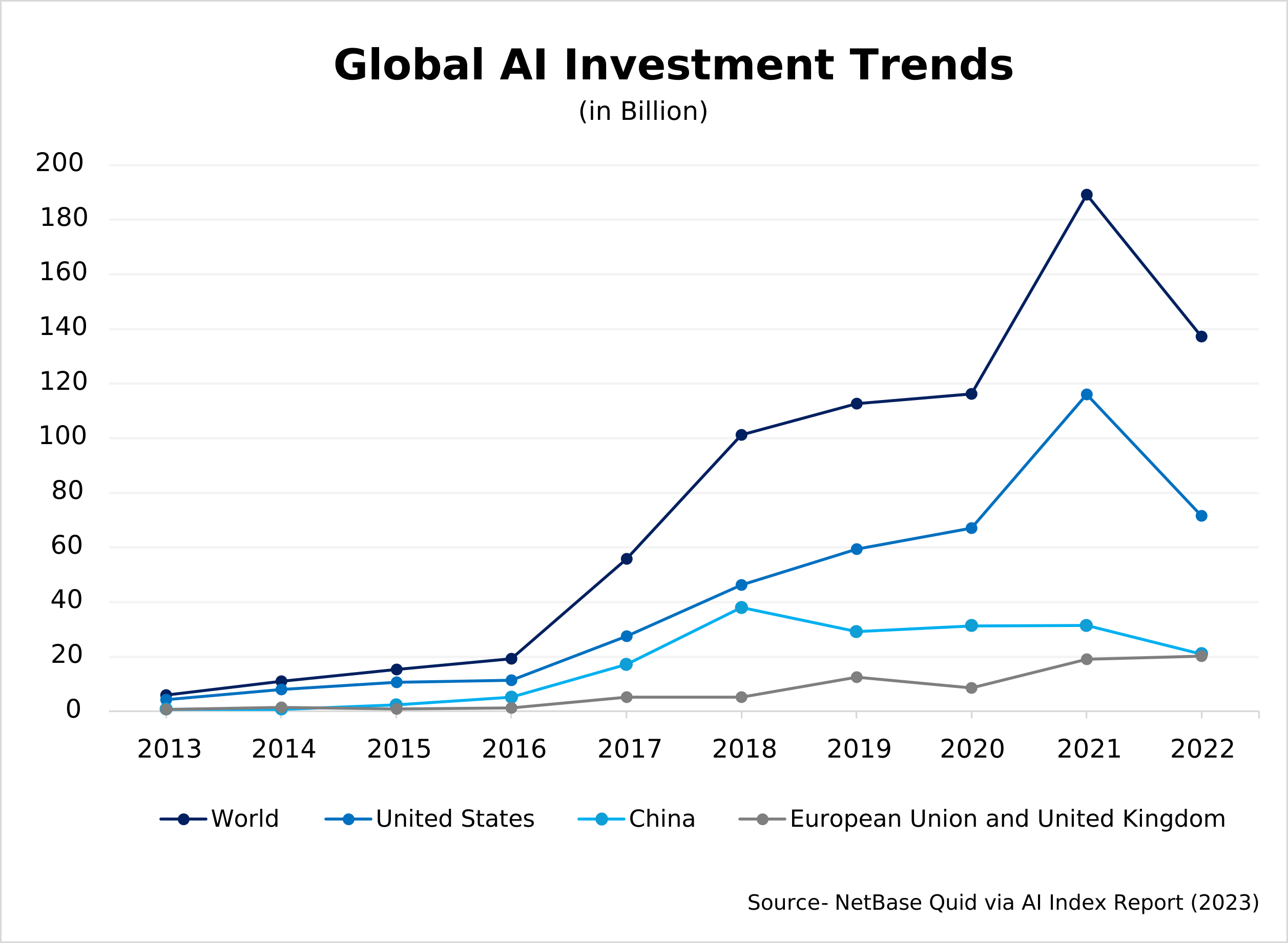
In 2022, private AI Investment within the U.S. was at the top with $43.9 billion, with $12.5 billion by China and $10.2 billion by the EU. These numbers show a marked global trend in investment. Historically, AI development was an international cooperative effort. Recently, strategies have shifted toward nationalistic approaches:
- United States: Vibrant ecosystem with minimal state intervention, favoring a free-market orientation.
- China: State-centric model targeting global leadership by 2030, using AI for economic and social control.
- EU: Strict regulatory focus, focusing on data protection and ethical AI within frameworks like GDPR and proposed AI Act.
Future Economic Trends and the Impact of AI
The economic patterns influenced by AI are vast with the promise of substantial growth in almost every sector such as healthcare, finance, and manufacturing:
- Innovation vs. Regulation: Characterized by an environment of innovation, the United States speeds up AI development with little government interfering. In the EU, on the other hand, stringent regulations could slow down the development process, while on the other hand, it enforces a set of rules and regulations in order to make certain that ethical AI deployment is reinforced. In China, on the other hand, with a state-centric approach, it can generate huge sector-based innovations.
- Digital Sovereignty and Supply Chains: Digitally sovereign moves into focus through acts such as the EU's Chips Act and China's chip making and acts as one of the tendencies toward self-sufficiency in the critical AI technologies that may redefine the world's supply.
Technological Decoupling and its Implications
Heating geopolitical tensions, in particular, between the U.S. and China, tend toward technological decoupling, which would drive divergent AI norms and break global interoperability:
- Implications for Global Markets: Such decoupling would break markets, change trade flows, increase costs, and damper innovation.
- Cybersecurity and Data Privacy: A nationalistic shift in AI development would only worsen problems of data security, pushing new international norms.
The Path Ahead
Balancing national interests with the need for global collaborative needs, particularly in shaping ethical AI norms and developing comprehensive data governance:
- Scope of Global Cooperation: While nationalistic considerations may come in the way, there is considerable space for global cooperation on AI, particularly across universal issues like climate change and healthcare.
- Economic Value in Cooperation: Joint efforts in AI would be mutually beneficial economically, driving forward global innovation and better consideration of societal issues.
Conclusion
The future of artificial intelligence is thus fast becoming apparent amidst the complex dynamics of global cooperation and nationalistic policies. How the global community navigates these complex dynamics will set the global economy and technology significantly, maximizing the confluence of the pursuit of national interest with the benefits of international cooperation.
Discover the Lean Advantage: Offshore Insight, Onshore Impact.
Lean Research enhances your investment strategy by delegating the detailed grunt work to our offshore analysts, freeing your onshore teams to focus on high-value tasks. With our dedicated full-time members embedded in your operations, we ensure that every piece of analysis not only meets but exceeds your standards. Experience the ease of expanding into new markets and asset classes while driving better investment returns, all in a cost-efficient manner. Lean Research is your partner in redefining asset management efficiency.