
2025 US Economic Outlook: Growth, Risks, and Investment Insights
The US economy starts 2025 with a complicated story of resilience, innovation and underlying risks. Strong GDP growth, big structural changes and a tight labor market have made the US the global economic leader. But inflation, fiscal deficits and geopolitical uncertainty temper the enthusiasm. This article looks at the whole picture, combining the good and the bad to give you the full view.
The US economy starts 2025 with a complicated story of resilience, innovation and underlying risks. Strong GDP growth, big structural changes and a tight labor market have made the US the global economic leader. But inflation, fiscal deficits and geopolitical uncertainty temper the enthusiasm. This article looks at the whole picture, combining the good and the bad to give you the full view.
Economic Growth: A Strong Yet Diverging Trajectory
The U.S. economy demonstrated steady growth in 2024, with GDP increasing by 2.8% in Q3, significantly exceeding the Congressional Budget Office's (CBO) long-term forecast of 2% growth. Looking ahead to 2025, a more moderate but still healthy growth rate of 2.3% is anticipated, fueled by robust consumer spending, corporate investments, and supportive fiscal policies.
In contrast, major global economies like Europe and Japan are facing slower growth due to stricter monetary policies and limited fiscal measures. This divergence underscores the unique resilience of the U.S., which is bolstered by its capacity to innovate and respond to macroeconomic challenges.
The Trump Effect: Policy Shifts and Economic Ramifications
The prospect of electing Donald Trump as U.S. President contains significant economic uncertainties. Policies he has thrown about, such as increased tariffs, lower taxes, and more rigorous measures in immigration, could reshape the American economy.
Key Implications:
- Higher Tariffs: The suggested 20% tariff on imports from Canada and Mexico, along with additional tariffs on Chinese goods, marks a shift away from the trade liberalization that has characterized the post-World War II era. While these tariffs aim to support domestic industries, they could lead to higher consumer prices, disrupt supply chains, and complicate the Federal Reserve’s efforts to control inflation.
- Tax Reductions: Lower taxes could stimulate corporate investments and consumer spending, boosting short-term GDP growth. However, they may exacerbate fiscal deficits, adding to the federal debt, which reached $36 trillion in 2024.
- Immigration Restrictions: Immigration constraints may stifle the labor supply leading to a wage inflation scenario to some extent, yet not enough labor under the roof to attain sectors critical to the economy.
These policies create a complex situation where inflationary pressures could rise, posing challenges for the Federal Reserve in its quest to maintain price stability.
The AI Revolution: Driving Structural Transformation
A key element that sets the U.S. apart is its leading role in the artificial intelligence (AI) revolution. In 2024, major technology companies like Microsoft, NVIDIA, and Alphabet invested nearly $50 billion, spurring progress in semiconductor manufacturing, data center growth, and supply chain automation.
Important statistics highlight the extent of this transformation:
- The U.S. hosts about 5,381 data centers, more than all other major economies like Germany, China, and Canada.
- Energy demand from data centers is set to triple by 2030, underscoring the need for significant infrastructure investment.
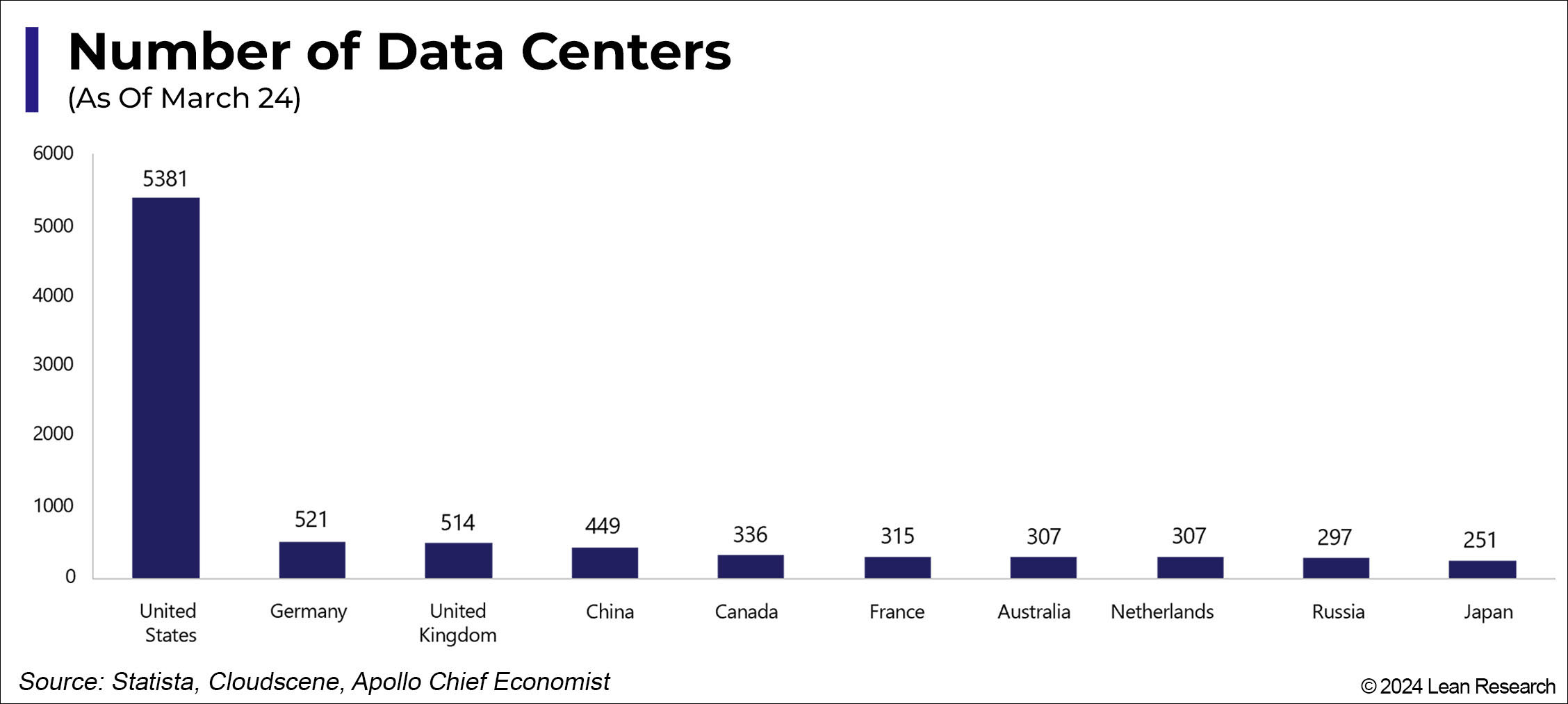
This innovation driven by AI has not only increased corporate spending but has also established the U.S. as a frontrunner in technologies that enhance productivity. Nevertheless, the swift adoption of AI presents challenges, including the risk of workforce displacement and ethical issues related to data privacy and automation.
Fiscal Policy: Accelerating Growth with Caveats
Federal policies like the CHIPS Act, the Inflation Reduction Act, and the Infrastructure Investment and Jobs Act have given a significant boost to the U.S. economy. These measures led to unprecedented spending on manufacturing construction, which topped $150 billion in 2024, highlighting a renewed commitment to domestic production.
The fiscal position of the U.S. government, marked by a 6% budget deficit, stands in stark contrast to the austerity measures seen in Europe, allowing for ongoing economic support. However, this strategy carries considerable risks. By 2024, federal debt had exceeded $36 trillion, with annual interest payments hitting a record $870 billion, surpassing defense spending for the first time. This situation raises concerns about the long-term viability of U.S. fiscal policy, especially as borrowing costs continue to climb.
Consumer Spending: Resilient but Bifurcated
The strength of the US economy continues to be built upon American consumers. Consumer spending advanced 3.7% in Q3 2024, underpinned by strong job creation, rising wages, and very low debt-to-income ratios. Aggregate measures like retail sales, air travel, and restaurant reservations continue to point to broad-based resiliency in discretionary spending.
However, the path of personal consumption has been anything but linear. When the Federal Reserve first raised interest rates in March 2022, consumer spending’s contribution to GDP sat at a modest 0.6%, as households adjusted to the shifting financial landscape. But the resilience of the American consumer soon became evident—despite higher borrowing costs, consumption surged to 3.3% by March 2023, a reflection of strong pent-up demand and wage growth.
Momentum fluctuated throughout 2023, dipping slightly mid-year before climbing again to 2.3% in December, as holiday spending and a tight labor market kept the economy on firm footing. By September 2024, consumer spending had rebounded further, contributing 2.5% to GDP, reinforcing its role as a primary driver of economic growth.
However, disparities are evident:
- Younger households are seeing an uptick in credit card delinquency rates, with those in their 20s facing more financial challenges than they did during the 2008 recession.
- High-income households, which are benefiting from increasing asset values and solid fixed-income returns, continue to account for a significant portion of consumer spending (40%).
This dichotomy reveals vulnerability in low-income groups, which may intensify under different economic conditions.
Corporate Performance: Resilience Amidst Higher Rates
Corporate America has shown impressive resilience in the face of the Federal Reserve’s rate hikes. Fixed-rate borrowing is prevalent, with the total value of investment-grade bonds outstanding soaring to $9 trillion in 2024, up from $3 trillion in 2015. This structural aspect has helped cushion the immediate effects of rising interest rates.
Corporate profitability is robust, with profits as a share of GDP hovering near historic highs. The number of bankruptcy filings and default rates for leveraged loans has decreased, indicating the overall strength of the corporate sector. However, small-cap companies, which tend to depend more on floating-rate debt, are more exposed to the challenges posed by high borrowing costs.
Inflation and Monetary Policy: Balancing Act
Inflation has decreased from its peak of 9.1% in 2022 to 2.6% in 2024, but it still exceeds the Federal Reserve’s target of 2%. Core inflation, largely influenced by housing costs, is expected to be 2.4% in 2025, which presents challenges for policymakers.
The Federal Reserve has started gradually reducing its interest rate, and is calling for a year-end 2025 federal funds rate at around 4.0%. However, any mistake in monetary policy—particularly over-reduction in the rates might fuel a back-surge in inflation, complicating the course to price stability.
A Data-Driven Approach to Portfolio Resilience in 2025
Financial markets in 2025 require a fresh approach to traditional portfolios as both risks and opportunities shift. Public equities, especially the S&P 500, are under pressure regarding valuations. A forward P/E ratio of 21.8 suggests inflation-adjusted returns of only 2.9% over the next three years, significantly lower than the historical average of 6.4%. The concentration of risks exacerbates this issue, with the top 10 companies—such as Tesla and NVIDIA—boasting an average P/E ratio of nearly 50, which is double that of the overall market.
Small-cap companies are facing additional challenges. More than half of the debt held by Russell 2000 firms is floating-rate, in contrast to 24% for S&P 500 companies, making these smaller entities more susceptible to ongoing high-interest rates. Earnings pressures are mounting, as a record number of Russell 2000 firms are reporting negative profits, indicating deeper structural issues.
Private markets are emerging as an attractive alternative. Private credit is yielding better returns than public high-yield bonds, with BDC income ETFs providing over 13% yields compared to 8% for U.S. high-yield corporate bonds. Hybrid strategies, such as mezzanine debt, offer equity-like upside while also providing downside protection, making them increasingly appealing. GP-led secondary deals now account for nearly half of private equity transactions, transforming capital markets and creating new opportunities.
The conventional 60/40 portfolio strategy is losing its effectiveness, given the reduced returns from public markets and tighter fixed-income spreads. Private markets can provide diversification and improved risk-reward potential, addressing the growing constraints of public assets.
In 2025, the key to resilience will be in harnessing the advantages of private markets and employing data-driven strategies. By concentrating on valuations, yields, and specific opportunities, portfolios can effectively manage risks while seizing growth in a complex financial environment.
Risks and Uncertainties: Navigating a Complex Landscape
While the U.S. economic outlook remains strong, significant risks warrant attention:
- Geopolitical Tensions: Conflicts in Ukraine and the Middle East, coupled with rising U.S.-China trade tensions, threaten global stability. These challenges could disrupt supply chains and dampen economic momentum.
- Fiscal Sustainability: Ballooning federal debt and deficits heighten the risk of fiscal strain, particularly as long-term interest rates rise.
- Housing Market Pressures: Limited housing inventory and rising demand from immigration (net inflow of 5.5 million people since 2020) contribute to persistently high housing costs, which may fuel inflation.
Financial markets reflect these uncertainties, with a 25% probability of recession priced in for 2025.
Conclusion: A Story of Strength and Vigilance
As the U.S. navigates 2025, its economic narrative is one of both opportunity and caution. Structural advantages, including leadership in AI and supportive fiscal policies, underpin resilience and growth. Yet, risks such as fiscal imbalances, inflationary pressures, and geopolitical uncertainties demand vigilance.
The U.S. economic story is far from static. It is a dynamic interplay of innovation, policy decisions, and global forces, offering lessons and challenges for businesses, policymakers, and individuals alike. Balancing growth with sustainability will be key to maintaining the nation’s economic leadership in the years ahead.
Discover the Lean Advantage: Offshore Insight Onshore Impact
Lean Research enhances your investment strategy by delegating the detailed grunt work to our offshore analysts, freeing your onshore teams to focus on high-value tasks. With our dedicated full-time members embedded in your operations, we ensure that every piece of analysis not only meets but exceeds your standards. Experience the ease of expanding into new markets and asset classes while driving better investment returns, all in a cost-efficient manner. Lean Research is your partner in redefining asset management efficiency.